Showing posts with label hiking. Show all posts

Saturday, October 24, 2009

Victorian Alps Alpine Crossing

Hotham to Bogong

Over the last couple of weeks, I've been studying track notes and poring over maps to come up with a plan to get on most of Victoria's Highest Mountains in one trip next winter.

Start: Diamantina Hut, Great Alpine Road, near Mount Hotham
End: Mountain Creek Campground, near Tawonga

Mountains to be Summited:
(in walking order)
Mt Feathertop (1922m)
Mt Jim (1818m)
Mt Cope (1837m)
Mt Nelse West (1893m)
Mt Nelse North (1885m)
Mt Bogong West Peak (1965m)
Mt Bogong (1986m)

THE PLAN :


Day One: Cross the exposed Razorback Trail (11km) and camp near Federation Hut. Ascend to the summit of Mt Feathertop (1922m). If it's windy or snowing heavily, get up to Federation Hut via Bungalow Spur from Harrietville instead.


Day Two:
Attempt Mt Feathertop again in the morning if the weather is clear. There should be plenty of time to get up Molly Hill and Little Feathertop as well if the weather is clear. Head down the steep Diamantina Spur down to the river, make camp near Blair's Hut.

Day Three: Get up on the Bogong High Plains and climb Mt Jim and Mt Cope. Probably will camp at Cope Hut. I wonder if I'll see any brumbies on this day.

Day Four: Cross the wind swept plains past Langford Gap to reach Fitzgerald Hut. Potentially organise a food drop from Falls Creek.

Day Five
It might be very windy and icy on Day 5 walking on the exposed Quartz Ridge to the highest point of Victoria. Unfortunately there is no other way to get there. Hopefully the wind won't rip us off the mountain on the way to Mt Bogong West Peak after passing Mt Nelse and Timm's Lookout. Get on the summit of Mount Bogong, and either camp at Gorge Gap or camp at Cleve Cole Hut.

Day Six
One more crack at Mt Bogong then time to head back. Get out of the cold and descend to Mountain Creek Camping Ground via the Staircase Spur.

Note:
  • We probably will allow two days for bad weather
  • We will carry an EPIRB beacon, snow shovel, crampons, ice axes, 4 season alpine tents, shellite stoves, etc.


Let me know if you are interested!!! I will be doing lots and lots of training prior to the trip.

Saturday, April 18, 2009

Overland Track Part III


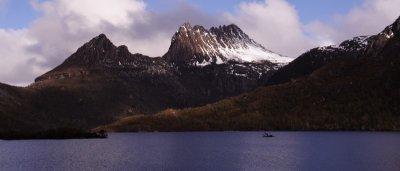
I'm almost certain to visit Tasmania for the third consecutive winter to do the Overland Track. The core group remains the same as the last two years but this year, we are more determined than ever to ascend to the majestic summits of Cradle Mountain and Mount Ossa. The plan is to stay in the northern section and we will have to wait patiently for the weather window to open to sneak up to the summits. The northern section is substantially higher than the southern end with lower temperature, higher winds and heavier snowfalls which means I probably need to carry some more food...


This will most probably be the last time I'll do this track in winter (for a while at least), so hopefully this year's mission will be a success. After experiencing the horrific weather in 2007, 2008 was relatively easy going but without one single mountain summited due to bad weather. Hopefully Overland Track Part III - The Final Act will be triumphant!

Sunday, March 22, 2009

Weekend Ride

Went out cycling yet again on Saturday as I continue to wait patiently for the best time to go hiking. The good news is Wilsons Prom has just been reopened to Day Visitors, with the longer walking tracks to be reopened shortly after. The fire threat has diminished to more sensible levels and the recent rain hopefully have re-filled the major water collection points along popular walking trails in Victoria.

Did the usual bike ride from home to Nunawading/Ringwood and back. Unfortunately, when I was riding back at a moderate speed of 25km/h, the bike chain snapped and literally flew off the bike into the bush. Somehow, my good luck didn't seem like ending. I didn't lose control or worse fall off the bike and crash into a tree. Unfortunately, it was a pretty sunny day and poor Tom walked all the way back to Kew from Nunawading (20km). * Sigh *, a 2 hour bike ride turned into a 4 hour trip, mostly walking in the sun pushing a bike...

Got the bike fixed 2 hours after in a bike shop and rode again on Sunday morning. I can't wait till the first hiking trip which is tentatively scheduled to take place this Easter. There's no better way of starting this year's hiking trips than visiting the highest peaks in Australia --- Kosciuszko National Park!

Thursday, March 5, 2009

More Gear!


I got myself a small, basic digital camcorder today. It's a Samsung MX20 - simple, lightweight and nothing fancy. You can call it a cheap and nasty digicam. I reckon it's perfect for bringing on an extended hiking trip when weight minimisation is of paramount importance. It's one of the lightest digicams around. I'll probably get to test it in the field in Easter, when I plan to start my first camping trip. If everything goes well, I'll take it on all the snow camping trips this winter. Hopefully I can bring back videos of the ascents, the campsites as well as the usual sill photographs.

I think I really need to get fitter with all these camera gear. My Digital SLR, its heavy lens (TWO lenses on some trips), extra batteries, memory cards, tripod and now a digicam! Easily 3-4kg worth of photography gear. No wonder sometimes people say I look like a one-man film crew... :)

Wednesday, February 18, 2009

Walking Poles


I just bought a new hiking pole (left) to replace the Leki pole
I snapped in Tasmania back in the winter of 2007 (middle). I don't normally carry one except on long trips with steep descents or some trips in the snow. Also shown in this shot is a wooden one (right) a friend of mine found and later presented to me complete with artistic carvings. HAHA

Someone asked me about Overland Winter 2007 the other day. Here's Day 1's Diary Entry (explaining how I managed to snap my brand new Leki pole) for those who are interested:


3 August 2007 Friday

Preliminaries

Shortly after entering into the World Heritage listed Cradle Mountain Lake St. Clair National Park, I could see from inside the comfort of the minibus that it was dumping snow outside with a gusty wind. It seemed peculiar to be isolated from the appalling conditions outside, knowing very well that sooner or later we had to get out and brace for the weather.

We arrived at the parks office early in the afternoon where we got out into the horrible weather, bought our park passes and gas canisters and registered our trip intention. I minimized weight as much as possible by depositing all my coins into the donation box in the parks office.

The mini bus managed to negotiate through the continuing snow and dropped us off at the Cradle Mountain Visitor car park at Dove Lake. Two years ago I was greeted with the sight of the majestic Cradle Mountain casting a perfect reflection on the lake under a clear blue sky. This time, visibility was down to 20m in heavy snow and the temperature hovering near 0 degree.

It was decided that with worsening conditions and fading light, it would be suicidal to get to Waterfall Valley Hut via the exposed Marions Lookout. It would be near impossible to stand up there, let alone trek! We would instead take the more sheltered route via Lake Rodway to Scott Kilbert Memorial Hut.

Drama getting to Scott Kilvert

After putting on the full snow weather gear, we started our journey towards the first night’s hut. I got off to the worst possible start while going up the first gentle climb out of Dove Lake. It was not a hard climb on soft snow but I managed to lose my footing and fell backwards after only five minutes of walking. Instinctively, I used my walking pole to break the heavy fall. The brand new Leki pole bore the full load of my weight and my 25kg pack and it snapped at the weakest point near the tip. It was heart breaking at first to see my $90 pole rendered useless after 5 minutes. Keen not to litter, I had to carry the dreaded thing for the next 8 days! Later on, I cheered myself up by thinking I would prefer the pole snapping rather than any of my limbs!

I put the pole snapping incident behind me and concentrated on following the party. The pack was at its heaviest for the trip and fortunately the terrain was not too steep to make the walk too strenuous. The unrelenting snowfall slowed us down considerably and it got dark just after 5pm. I switched on my head torch and put all my faith on Bruce to be able to lead us to Scott Kilvert.

While we were dashing through the quickly disappearing trail in the dark, I kept a constant look at my watch. Time was ticking fast and I wondered whether the first night of this adventure will be spent in the tent.

Bruce ignored one of the signs at one point and relied on his experience in the area to guide us closer to the hut. The snowfall was continuing and visibility was getting worse by the minute. I had little time to think about anything else other than to keep focused and to stay alert on where I placed my feet.

Thankfully, Bruce finally managed to guide the team into Scott Kilvert shortly after 7pm.

Paul had arrived earlier than the rest of us and had started the coal heater. Unlike the other huts in the National Park, this hut has two floors connected by a flight of wooden stairs. The ground floor has the benches and seats with the fireplace. Upstairs is the sleeping area with enough room to fit about 15 people sleeping side by side.

The hut was bursting with activities in no time as all of us started arranging our gear and cooking our first dinner for the trip. It was quickly infused with the different fragrances as the dinners were heated. It was amazing that all these were done under torch light in a crowded hut.

Bruce went out and located the path to the pit toilet through the snow covered forest. It turned out he had to dig out the thick layer of snow that was blocking the door. Later at night when I visited the toilet, I thought it would be impossible for me to find such a tiny structure blanketed in snow in the dark.

I was very excited that night about the trip but I knew I had to get some sleep for tomorrow’s struggle in the snow.

Friday, February 6, 2009

Hiking Trip Diaries

I started keeping travel diaries around the year 2000. I didn't write much in the first few years but really picked up on the writing a few years ago. Sometimes I might be writing in the comfort of a mountain hut, away from the elements outside. In other times, I find myself wrapped in my down sleeping bag in the tent, jotting down notes with the light from my head-torch.

I find that by writing as much as I can, I am able to capture all the excitement, laughter and drama from each trip. Nowadays, I often find myself reading my old trip diaries in the evening after work, imaging I am back in the Himalayas in Nepal or heading up the steep ridges in the Alpine National Park in deep snow. Of course, how can I forget the Overland Track Expedition in the Winter of 2007.

An added benefit that I hadn't thought of previously is to publish edited versions online. After the epic Overland Track walk in the winter of 2007, the editor of YHA Bushwalking Club's magazine asked me to write a 2-page article on the trip upon hearing what happened. Here is a link to the archived magazine: Yeti Issue 30. My article is somewhere in the middle. Second contribution was published last year, an interview published in Yeti Issue 31.

I intent to keep writing and share all the magical experience with my friends and people with similar interests in exploring the wilderness.

Tuesday, February 3, 2009

10-Day Mountaineering Course in New Zealand

In December 2008, I joined a commercial mountaineering instruction course in New Zealand, organised by a Wanaka based adventure company. (and Yes – without doing advertising for them, it is the one that lead the ill-fated 1996 Everest Expedition featured in the best selling book – “Into Thin Air”) Let me start by saying I have got absolutely no ambition to climb Everest or the like. However, my goal is to do a few much easier peaks with a guide or a group of friends experienced in mountaineering once I acquired the necessary skills. I enjoy landscape photography and I hope one day I can get on top of a 5000-6000m peak, taking panoramic photos of snow-capped mountains above the clouds as the morning sun slowly rises above the horizon.

We had five students and two guides on the course, all students are from Australia. I have prepared the shortened form of my trip diary to give you a taste of what it was like. You can f
ind more photos taken on the trip on my pbase gallery here.

Day 1 and 2: Rain Rain Rain!

We spent two days in the tiny town of Fox Glacier while waiting for the notorious weather in the West Coast to clear up. The area gets 7 metres of rain per year and by the end of Day 2 I was wondering if we should just build a pipe from Melbourne to Fox Glacier instead of the Desalination Plant in Wonthaggi. More reliable, less impact on the environment and possibly cheaper! We learned a bit of theory, different knots, rope-work and even did some Prusik-ing up a rope indoors in the community hall! It felt strange trying to imagine the roof of the community hall were the lip of this huge crevasse I desperately need to get to…

Day 3: Lift Off


The weather window finally opened early in the morning. It was a truly amazing experience sitting in a chopper for the first time, flying over the majestic Fox Glacier, catching glimpse
s of Mt Cook and Mt Tasman, before landing on a tiny icy ledge just above Centennial Hut. Moved all provisions inside and learned how to build different snow anchors for the rest of the day. It was a lot of fun learning the different ways of self-arresting. (Using an ice axe to halt a slide down an icy slope) The hardest technique to master was to dive head first, face up, down a steep icy slope and try to self-arrest to halt the slide. It was hard to concentrate on where to plant the axe when I all I could see was the sky above as I was zooming down the hill at high speed on my back. Practised a number of times but the best I could manage was to slow the fall, not arresting it. Well, hopefully I won’t be falling face up, head down first during any stage of this course!

We had to melt snow/ice for dinner as the water tank was broken by a climber last week who decided the easiest way to loosen the ice in the tank was to kick the tank with his crampons on… Sigh…

Day 4: Trapped indoors


The wind speed exceeded 100km/h and it rained/hailed/snowed heavily for 24 hours non-stop. If you want to know how bad this was: consider these two facts: (1) Nobody got out of the hut to the toilet hut which was a mere 5 metres away for fear of being ripped off the mountain by the ferocious storm. We used the super high-tech Bucket Method™ instead. (2) I felt the wall of the hut moving during the night, the steel frame gently swaying with the wind.

Just after I convinced myself there was nothing to worry about, the guides informed me another hut nearby was blown away a few years ago in a similar storm, along with all 4 or 5 occupants down the sheer cliff …

Day 5: Fantastic day of sunshine


Learned crevasse rescue, more anchoring and rope-work. The views were absolutely stunning, well worth the price of the course alone. I kept re-applying sun-screen every hour to combat the blazing sun reflected off all the snow around me. Believe me, I felt just as warm during the 43° heat-wave in Melbourne as the kind of heat/sun I experienced in the Southern Alps of New Zealand. Unfortunately I only brought along 2L of water for the outing and I paid dearly for it near the end of the exercise as I was very dehydrated and slightly dizzy by the time I returned back to Centennial Hut. The worst thing was having to wait for the snow to melt to get a drink!

Day 6: The Walk-out/Fly-Out day


With the weather window closing on Day 7, we had to get back down to the village in order to avoid being trapped for days up the mountain. Quite often, there are people who get stuck high up in the mountain huts for more than a week because they missed their opportunity to get out while the weather window was open. We walked along Fox Glacier to get to Chancellor Hut for our chopper ride, making full use of our newly learned glacier travel technique. We climbed our first New Zealand Peak - Von Barlow after making a couple of pitches under supervision. We even practised our summit poses on top!

It was another blazing hot day in the Southern Alps. The snow was softening at an alarming rate, making glacier travel more dangerous as the snow bridges got weaker and weaker. Near the end of the day, I punched straight through a severely weakened snow-bridge across a crevasse. There is nothing more terrifying than seeing the snow crumpled and a bottomless crevasse appear right in front of my eyes! I must have done something right as the chest harness I tied in the morning held! Understandably, my guide didn’t want me to practise my Prusik-ing skills to get out while he was on the other end of the rope attached to a novice climber dangling above a crevasse. I was dragged out instead…

We got to see the beautiful Fox Glacier one more
time as we flew back on a helicopter from Chancellor Hut.

Day 7: Franz Josef Glacier


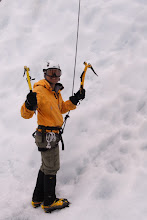
We visited the nearby Franz Josef Glacier to learn ice-climbing. Once the ropes were set up, we were like the circus monkeys performing tricks for the hundreds of tourists visiting the Glacier as they stopped, watched and photographed us playing around. I must say the ice-climbing session was one of the highlights of the trip.

Day 8: Another rainy day in South Island

Travel Day from West Coast back to base in Wanaka. Boring apart from travelling on all those one-lane bridges on the 100km/h highway, wondering if the NZ traffic engineers got all the sight distances correctly worked out for vehicles coming from the other end…

Day 9 & 10 Rock Climbing

We practised our outdoor rock climbing skills, which included setting up rock anchors and trying to climb on rock wearing rigid mountaineering boots. We learned a bit of abseiling as well near the end. All the students got issued with certificates on the last day. A couple of them climbed Mt Cook a week later with the guides!

After the course - Coming to terms with the dangers of mountaineering

Around the time I was in New Zealand, four people died in three separate accidents visiting similar places I went to during the course. Even though I won’t be doing anything extreme like climbing Mt Cook without a guide, these events really highlighted the dangers that are associated with the sport.

When we were staying at Centennial Hut, two Japanese climbers were attempting the nearby Mt Cook. On the day we were trapped in the hut by the 100km/h+ raging wind, they were struggling to survive in their snow cave on Mt Cook. Details of what happened are still sketchy and might never be known. Their snow cave was hastily excavated with a ball point pen as hell descended fast upon them. Rescuers could not get to them for days due to the appalling weather. Somehow the rescuers managed to drop a pack of supplies & radio 2m away from their tent and yet the climbers could not hear or see the pack in the ferocious weather. The Japanese guide died a couple of days later due to prolonged exposure. The client was rescued relatively unharmed, suffering hypothermia. It was a real shock when we got out and read it on the newspaper.

Three other Australians died in Mt Cook and Fox Glacier within a couple of weeks later.

Sunday, February 1, 2009

Old Video of my tent withstanding the strong wind

Taken on 1 January 2006 in Kosciuszko National Park

Strong winds at our campsite near the summit of Mt Townsend, one of the highest mountains in Australia standing at 2209m. The wind was hammering my 3 season tent from about 3am and at times I thought it was going to rip away. It was hard to get any sleep as I kept seeing the tent poles bending and twisting. Probably one of the windiest day I've experienced on my trips.